How Coins Are Designed in the U.S., Using the 2027 Quarters as the Example
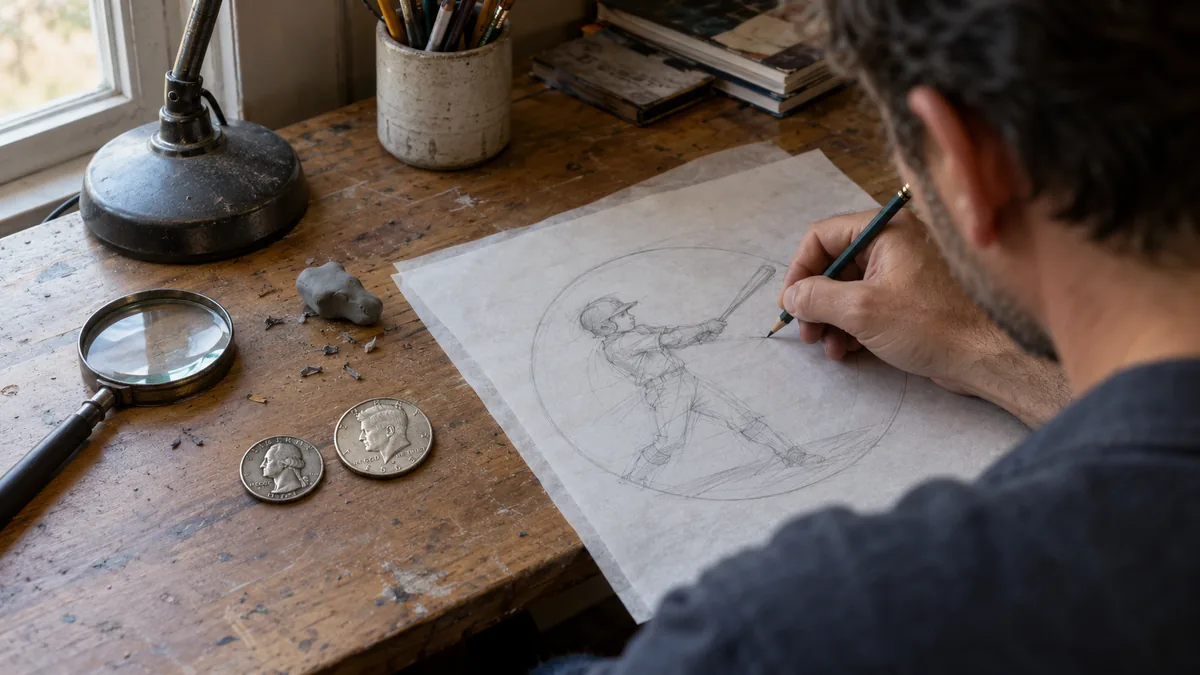
Here is how coins are designed in the United States: Congress or the Treasury authorizes a coin, the Mint's Office of Design Management writes a brief, Mint staff and contract artists draw candidates, two advisory panels (the CCAC and the CFA) review and recommend, and the Treasury Secretary picks the final design. Mint artists then sculpt it and make the dies.
How coins are designed, step by step
The Mint describes the process in its design and selection article. The order is the same for a circulating quarter, a commemorative silver dollar or a Congressional Gold Medal, though the people involved change.
| Step | Who does it | What happens |
|---|---|---|
| 1. Authority | Congress, or the Treasury Secretary for some gold coins and medals | A law sets the coin, the years, required inscriptions and often the theme |
| 2. Brief | Office of Design Management, with stakeholders | The Mint writes a design brief and holds a kickoff call with subject experts |
| 3. Drawings | Mint medallic artists and Artistic Infusion Program artists | Artists research and submit line drawings |
| 4. Internal review | Legal staff, chief engraver, technical staff | Checks for legal requirements, copyright, accuracy and whether the design will strike well |
| 5. Stakeholder review | Liaisons named in the law or chosen by the Mint | Accuracy checks and revisions until the portfolio is ready |
| 6. Advisory review | CCAC and CFA | Each panel meets in public and recommends a design to the Secretary |
| 7. Final choice | Secretary of the Treasury | Selects the design, which is still line art |
| 8. Sculpt and dies | Mint medallic artists, manufacturing staff | Sculpting in clay or digitally, master hub, dies, test strike |
Step 1: the law comes first
Every new coin starts with legal authority. For the 2027 to 2030 Youth Sports Quarters that authority is Public Law 116-330, the Circulating Collectible Coin Redesign Act of 2020. It says the quarter reverse will show youth sports, one sport per coin and up to five a year, and that designs are chosen by the Secretary "after consultation with the Commission of Fine Arts and review by the Citizens Coinage Advisory Committee." The same law sets up the Paralympic half dollar and requires consultation with U.S. Paralympics on those designs.
Laws can be very specific. The 2014 Baseball Hall of Fame law required a baseball on the reverse and a public competition for the obverse, which we cover in our baseball coin history. Others leave almost everything to the Mint. The quarter law left the choice of sports to the Secretary after public outreach, which led to a 2025 survey of 58 sports. Our page on how the sports were chosen covers that step.
Who designs U.S. coins
Two groups of artists draw nearly every modern coin. The first is the Mint's own staff of medallic artists in Philadelphia, who can submit designs for any program and who sculpt the selected designs for production. The second is the Artistic Infusion Program, or AIP. The Mint's artists page says the AIP was set up in 2003 and contracts professional American artists who work with Mint staff to create new coin and medal designs. The page listed 36 current AIP designers when we checked. Artists join through occasional calls for applications, and on most coins the AIP artist's initials appear next to those of the Mint artist who sculpted the design.
The 2027 half dollar shows how this works. CoinNews credits AIP artist Beth Zaiken with the new Kennedy portrait, sculpted by Craig A. Campbell, and AIP artist Walter O'Neal III with the wheelchair basketball reverse, sculpted by Eric David Custer.
Sometimes the public gets a turn. A law can require an open competition, as with the 2014 baseball glove design, which drew 178 entries.
The Office of Design Management and the liaisons
The Office of Design Management runs the process inside the Mint. Its design managers write the brief, gather research, collect drawings, route them through legal and technical review and present the portfolios to the advisory panels. A Mint design manager has called the office "neutral stewards of the process."
Liaisons and subject experts keep the designs accurate. For the 2027 Paralympic half dollar, the CCAC heard from Matt Torres of the National Wheelchair Basketball Association, according to the meeting minutes. That is how a design ends up with the right ball: the CCAC asked that the coin show a Molten ball, the official game ball for the sport. The minutes list no outside sports experts for the five quarter reverses at that meeting.
The Citizens Coinage Advisory Committee
The CCAC was created by Congress in 2003 (Public Law 108-15) to advise the Treasury Secretary on coin and medal themes and designs. The CCAC's about page says it meets at least twice a year in public and streams its meetings. Under 31 U.S.C. 5135 it has 11 members, all appointed by the Secretary. Seven are picked directly (including specialists in numismatic collections, medallic art or sculpture, American history and numismatics, plus three members of the public), and four come from recommendations by the leaders of the House and Senate. Members serve four-year terms without pay.
The 0 to 3 scoring system
Each member scores every candidate design 0, 1, 2 or 3 points, with higher numbers meaning a more favorable opinion, a method recorded in CCAC minutes going back to at least 2008. With 11 members voting, the maximum is 33 points. The top scorer usually becomes the recommendation, which the committee confirms by motion and sends to the Secretary in a letter. Ties go to a roll-call vote.
The 2027 quarters at the CCAC
At its February 24, 2026 meeting, with all 11 members present, the CCAC scored the five 2027 reverses. The minutes record soccer SOCC-07 at 28 of 33 points, baseball BASE-01 at 22, softball SOFT-04A at 21, snowboarding SNOW-03 at 20 and golf GOLF-07 at 15. Golf and snowboarding were ties, broken by 6 to 5 roll calls over GOLF-02 and SNOW-06. The committee also voted unanimously to ask that the catcher's mask on BASE-01 sit more naturally on the catcher's face.
The Commission of Fine Arts
The CFA is older and broader. It dates to 1910, and its seven members are appointed by the president, with expertise in art, architecture and design. Its coin role goes back to a 1921 executive order requiring that coin and medal designs be submitted to the Commission "for advice as to the merits of such designs." The CFA reviews designs for all coins and medals issued by the Mint. It does not publish point scores. Instead it votes on a recommendation and sends a letter.
The CFA looked at the 2027 quarters first, on February 19, 2026, and wrote to the Mint on February 27. Its letter recommended baseball #1, golf #4, soccer #1, softball #4 and snowboarding #3. It asked that the catcher's mask read clearly as face protection, that home plate be removed from the softball design, and that the soccer player's jersey carry the number 47 "in honor of the president."
When the two panels disagree: how the 2027 review ended
The CCAC and CFA are advisers, and they often split. On the 2027 quarters they agreed on the catcher's mask fix but not always on the designs. On the new George Washington obverse the CCAC chose GW-01 (November 18, 2025) while the CFA chose GW-03A (January 22, 2026), which shows Washington in uniform as leader of the Continental Army. On the half dollar the CCAC chose Kennedy portrait JFK-02 and the CFA chose #4, and for the wheelchair basketball reverse the CCAC chose 50c-WCBB-01 and the CFA its #7. The Secretary can follow either panel, combine their suggestions, or pick something else from the portfolio.
The answer came on October 26, 2026, when the Mint published the final 2027 designs. The Mint did not publish design codes, so the table matches each finished design to the candidate line art the panels reviewed.
| Design | CCAC pick | CFA pick | Final design |
|---|---|---|---|
| Washington obverse | GW-01 | GW-03A | GW-01 (CCAC) |
| Baseball | BASE-01 | #1 | BASE-01 (both) |
| Golf | GOLF-07 | #4 | GOLF-07 (CCAC) |
| Soccer | SOCC-07 | #1 | SOCC-01 (CFA) |
| Softball | SOFT-04A | #4 | SOFT-04A (CCAC) |
| Snowboarding | SNOW-03 | #3 | SNOW-03 (both) |
| Kennedy obverse | JFK-02 | #4 | JFK-04 (CFA) |
| Half dollar reverse | 50c-WCBB-01 | #7 | 50c-WCBB-01 (CCAC) |
The CCAC's pick was used four times (the Washington obverse, golf, softball and the half dollar reverse), the CFA's twice (soccer and the Kennedy portrait), and on baseball and snowboarding the panels had already agreed. SOCC-07 had the CCAC's top 2027 score, 28 of 33, and still lost. Requests were not always followed. The CFA asked for home plate to be removed from the softball design, but the final coin keeps it, with 2027 on the plate. The Mint's image of the soccer coin shows no number 47 on the shirt.
Release dates, mintages and designer credits for the quarters had not been announced as of late October 2026. Our 2027 quarters page and the obverse page show each final design, and the 2027 Kennedy half dollar page covers the half.
From line art to a coin
The selected design is still a drawing. A Mint medallic artist sculpts it, in clay or digitally, and the finished sculpt is used to make a master hub, which makes the working dies. The manufacturing team runs a test strike to find any part of the design that does not strike well before production begins. Fine details that look good on paper can fail at quarter size, which is one reason the technical review comes so early.
For more on what happens after the design is final, see our guide to the 2027 coins. Our editorial standards explain how we source these facts.
Frequently asked questions
- Who designs U.S. coins?
- Mint staff medallic artists and contract artists in the Artistic Infusion Program draw most designs. Some laws require a public competition instead.
- Who chooses the final coin design?
- The Secretary of the Treasury, after the Citizens Coinage Advisory Committee and the Commission of Fine Arts make their recommendations. The Secretary is not bound by either panel.
- How does CCAC scoring work?
- Each of the 11 members gives each design 0, 1, 2 or 3 points, so the maximum is 33. The top score usually becomes the committee's recommendation, and ties go to a roll-call vote.
- What is the Artistic Infusion Program?
- A Mint program started in 2003 that contracts professional American artists to design coins and medals alongside Mint staff. Their initials usually appear on the coins they design.
- Have the 2027 Youth Sports Quarter designs been chosen?
- Yes. The Mint published the final designs on October 26, 2026. The CCAC's pick was used for golf, softball and the Washington obverse, the CFA's for soccer, and both panels had chosen the baseball and snowboarding designs.
Sources
- U.S. Mint: How Coins Are Made, Design and Selection Process
- U.S. Mint: Artists (Artistic Infusion Program)
- CCAC: About
- 31 U.S.C. 5135, Citizens Coinage Advisory Committee (Cornell LII)
- CCAC minutes, February 24, 2026
- CCAC minutes, August 1, 2008 (scoring method)
- CFA letter on 2027 Youth Sports Quarter reverses
- CFA: Executive Order 3524 (1921)
- CFA: Government Projects
- U.S. Mint: High relief gold coin and the two advisory groups
Published 10 November 2026. Facts checked against the sources listed above. The 2027 designs are final, published by the U.S. Mint on 26 October 2026; later years' designs are not chosen yet.