Every U.S. Baseball Coin, From the Curved 2014 Issue to the 2027 Quarter
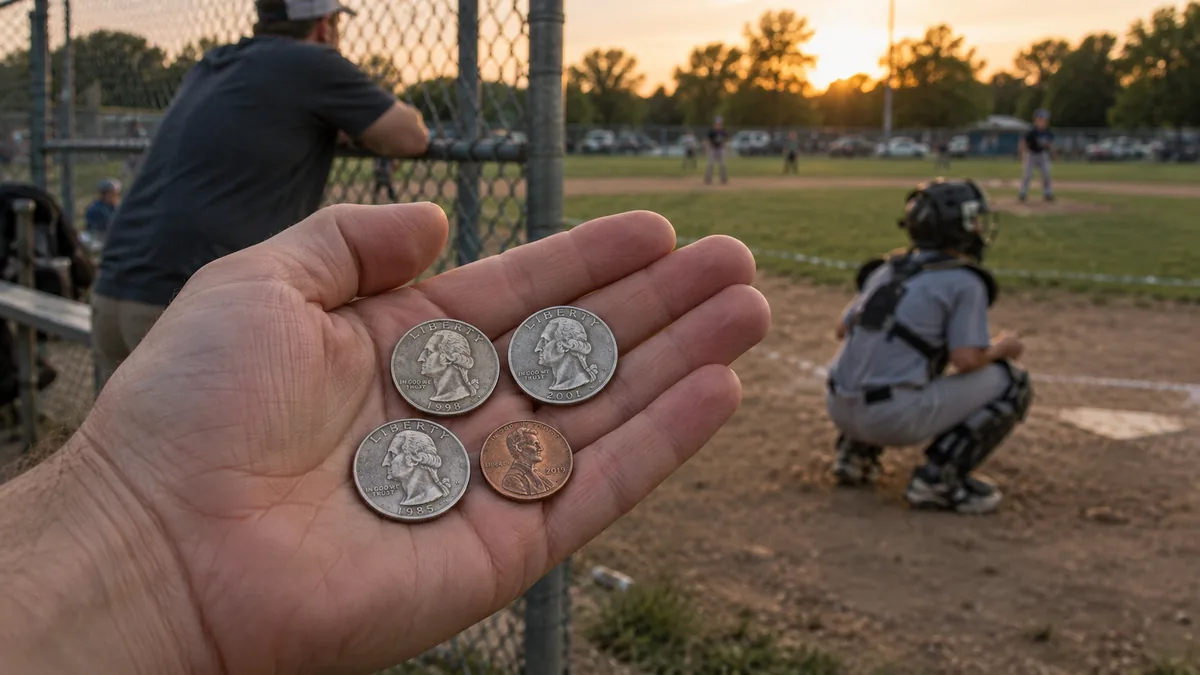
A baseball coin from the U.S. Mint is a short list: the 1992 Olympic silver dollar, the 1995 Olympic baseball half dollar, the 1997 Jackie Robinson coins, the curved 2014 National Baseball Hall of Fame coins, the 2022 Negro Leagues Baseball coins, and the 2027 baseball quarter from the Youth Sports series. Only the quarter will circulate. The others are commemoratives sold by the Mint at a premium.
Every U.S. baseball coin at a glance
The table lists the baseball coins we could confirm from Mint, congressional and PCGS records. Mintages for the 2014 coins come from PCGS CoinFacts. For the 2022 coins we list the legal maximums, because we have not found final production figures published by the Mint.
| Year | Coin | Denominations | Authority | Mintage |
|---|---|---|---|---|
| 1992 | Olympic silver dollar (baseball pitcher) | $1 silver | Public Law 101-406 | 187,552 uncirculated (1992-D); 504,505 proof (1992-S) |
| 1995 | Atlanta Olympic baseball half dollar | Clad half dollar | Public Law 102-390 | 164,605 uncirculated (1995-S) |
| 1997 | Jackie Robinson | $5 gold, $1 silver | Public Law 104-329 | Gold: 5,174 unc (PCGS) |
| 2014 | National Baseball Hall of Fame | $5 gold, $1 silver, clad half dollar | Public Law 112-152 | Gold: 17,674 unc, 32,428 proof. Silver: 131,910 unc, 267,847 proof. Half: 142,405 unc, 249,049 proof |
| 2022 | Negro Leagues Baseball | $5 gold, $1 silver, clad half dollar | Public Law 116-209 | Caps: 50,000 gold, 400,000 silver, 400,000 half dollars |
| 2027 | Youth Sports baseball quarter (design BASE-01) | Circulating quarter | Public Law 116-330 | Not announced as of late October 2026 |
The 1992 Olympic baseball coin
The first baseball coin from the Mint was a sideline to the Olympics. The 1992 Olympic program raised money for American athletes heading to the Barcelona Games, and its silver dollar shows a pitcher throwing toward home plate with the Olympic rings. The Mint's 1992 Olympics page credits John R. Deecken with the obverse design and gives a release date of January 17, 1992. Surcharges went to the United States Olympic Committee.
PCGS CoinFacts lists 187,552 uncirculated coins from Denver and 504,505 proofs from San Francisco. The coin is 90% silver, 38.1 mm across and 26.73 grams. PCGS also notes that the pitcher drew criticism almost at once for looking very much like a 1991 Nolan Ryan baseball card.
Two more baseball commemoratives followed. The 1995 Atlanta Centennial Olympic program included a clad baseball half dollar showing a hitter, a catcher and an umpire; PCGS CoinFacts lists 164,605 uncirculated coins from San Francisco. In 1997, under Public Law 104-329, the Mint issued a $5 gold coin and a silver dollar for the 50th anniversary of Jackie Robinson breaking the major league color barrier. PCGS lists only 5,174 uncirculated gold coins.
2014 Hall of Fame: the curved baseball coin
The coin most collectors mean when they say "baseball coin" is the 2014 National Baseball Hall of Fame issue. Congress authorized it in the National Baseball Hall of Fame Commemorative Coin Act, Public Law 112-152, approved August 3, 2012, to mark the Hall's 75th anniversary. The law allowed up to 50,000 gold $5 coins, 400,000 silver dollars and 750,000 clad half dollars, all dated 2014 and all sharing one obverse and one reverse.
Why the coins are curved
The law asked, as a "sense of Congress," that the coins be shaped like a ball and glove: a convex reverse showing a baseball and a concave obverse. The Mint's program page says these were "the first curved coins ever minted by the U.S. Mint." The Act pointed to the 2009 International Year of Astronomy coins from the Monnaie de Paris as a model, and the Mint says it drew on technical advice from the Royal Australian and Perth Mints. Research covered relief height, milling, laser frosting and proof polishing before full production.
A public design contest
The reverse baseball was fixed by law. The glove on the obverse came from an open competition that ran April 11 to May 11, 2013, and drew 178 entries. Mint sculptor-engravers and a Bureau of Engraving and Printing designer scored them, five Hall of Fame members narrowed the semifinalists to 16 finalists. The Treasury picked the winner on September 9, 2013: Cassie McFarland of San Luis Obispo, California. PCGS credits the final coin to McFarland and Mint sculptor Don Everhart.
The coins went on sale March 27, 2014, at a Capitol Hill event, according to the Mint's launch release. Surcharges of $35 per gold coin, $10 per silver dollar and $5 per half dollar went to the Hall of Fame.
How many were made
PCGS CoinFacts lists 17,674 uncirculated and 32,428 proof gold coins, 131,910 uncirculated and 267,847 proof silver dollars, and 142,405 uncirculated and 249,049 proof half dollars. The two gold figures add up to slightly more than the 50,000 cap in the law, so treat them as PCGS's published numbers rather than an audited Mint total. Of the six versions, the proof silver dollar had the largest mintage, which is one reason it turns up so often in collections and at coin shows. The uncirculated gold coin, at under 18,000 pieces, is the scarcest.
2022 Negro Leagues Baseball coins
Public Law 116-209, approved December 4, 2020, created a three-coin program for the 100th anniversary of the Negro National League. Sales opened January 6, 2022, and the law allowed issue only during 2022. Surcharges ($35, $10 and $5 per coin) went to the Negro Leagues Baseball Museum in Kansas City for educational programs and exhibits.
Unlike the 2014 issue, each denomination got its own designs, all by Artistic Infusion Program artists. The Mint unveiled them on November 10, 2021, at the museum. According to the Mint's design announcement:
- $5 gold: a portrait of the founder of the Negro National League (Laurie Musser) and a player tipping his cap (Donna Weaver).
- Silver dollar: a pitcher with a border of baseball stitching (Matt Swaim) and a player's-eye view of a pitch reaching the catcher (Don Everhart).
- Half dollar: a Negro Leagues tour bus with a batter at the plate (Chris Costello) and a group of players (Justin Kunz).
The 2022 coins came out eight years after the Hall of Fame issue and took a different approach. Instead of one shared design meant to look like equipment, the six designs tell a story: the founder, the players, the long bus trips between games. The law required the designs to be emblematic of the museum's mission to promote tolerance, diversity and inclusion.
The Mint also sold a silver dollar with a "100" privy mark, limited to 20,000 units, and a set pairing the dollar with a Jackie Robinson medal, limited to 15,000.
The 2027 baseball quarter
The next baseball coin is the first one most people will find in change. Baseball is one of the five 2027 sports in the Youth Sports Quarters program created by Public Law 116-330, which the Mint now calls the Youth Sports Coin Collection. Both review panels weighed in on the reverse. The Citizens Coinage Advisory Committee met February 24, 2026, and recommended design BASE-01 with 22 of 33 possible points. The Commission of Fine Arts met February 19, 2026, and in its letter to the Mint chose design #1 for its "affinity with traditional American illustration."
The two panels also agreed on a detail: both asked the Mint to fix the catcher's mask. The CCAC wanted it placed more naturally on the catcher's face, and the CFA asked that it read clearly as face protection.
The Mint published the final design on October 26, 2026, and the finished coin matches BASE-01, the design both panels picked. A young batter stands ready at home plate with the bat raised, a crouching catcher waits behind, a section of fence fills the background, and 2027 runs across the bottom. Like every reverse in the series, it carries the sport's name, the year and UNITED STATES OF AMERICA. The obverse is the new George Washington portrait shared by all 20 quarters. Release dates and mintage had not been announced as of late October 2026. Our baseball quarter page shows the final design, and the 2027 quarters overview compares all five sports.
The quarter will be worth 25 cents in change. Its value to a collector is in finding one, not in resale. If you want a clean example, the Mint normally sells rolls and bags of new quarters, and the proof and uncirculated sets include them, but the Mint has not announced 2027 product dates for the baseball design yet.
Collecting baseball coins on a budget
A full run of U.S. baseball coins is within reach for most collectors except for the gold. A few practical points:
- Start with the 2027 quarter from circulation, then add the uncirculated and proof versions. The 2027 proof set lists the 2027 Youth Sports Quarters, all with an S mint mark.
- The clad half dollars from 2014 and 2022 are the cheapest way to own a commemorative baseball coin.
- For the 2014 issue, check that the curve is intact. A dent on a domed coin is easy to see and hard to ignore.
- Keep coins in their original Mint packaging or a holder. Our coin collecting for kids post covers simple storage.
Baseball is not the only sport the Mint has put on coins. Our history of sports on U.S. coins puts these issues alongside the other sports the Mint has honored, and the softball quarter joins baseball in 2027. When the Mint names release dates, they will go on our release dates page.
Frequently asked questions
- What was the first curved U.S. coin?
- The 2014 National Baseball Hall of Fame commemoratives. The Mint calls them the first curved coins it ever minted, with a concave glove side and a convex baseball side.
- Who designed the 2014 baseball coin?
- Cassie McFarland of San Luis Obispo, California, won the public design competition for the glove obverse. The baseball reverse was required by law, and PCGS credits Mint sculptor Don Everhart on the final coin.
- How many 2014 baseball silver dollars were made?
- PCGS CoinFacts lists 131,910 uncirculated and 267,847 proof silver dollars. The law allowed up to 400,000.
- Is there a baseball quarter?
- Yes. Baseball is one of the five 2027 Youth Sports Quarters. The Mint published the final design on October 26, 2026: it matches BASE-01, a young batter at home plate with a crouching catcher behind, the design both review panels picked.
- Will the baseball quarter be worth more than 25 cents?
- A circulated 2027 baseball quarter will be worth face value. Uncirculated and proof versions sold by the Mint cost more, but no one can know their future value.
Sources
- U.S. Mint: National Baseball Hall of Fame Commemorative Coin Program
- U.S. Mint press release: National Baseball Hall of Fame coin launch (March 27, 2014)
- Public Law 112-152 (govinfo)
- PCGS CoinFacts: 1995-S 50C Baseball
- U.S. Mint: Negro Leagues Baseball commemorative coin designs unveiled
- Public Law 116-209 (govinfo)
- U.S. Mint: 1992 Olympics commemorative coin
- PCGS CoinFacts: 1992-S $1 Olympic Proof
- CFA letter on 2027 Youth Sports Quarter reverses (19 Feb 2026 meeting)
- CCAC letter to the Secretary on 2027 Youth Sports Quarters
Published 7 November 2026. Facts checked against the sources listed above. The 2027 designs are final, published by the U.S. Mint on 26 October 2026; later years' designs are not chosen yet.